
Source of cover image: NASA / VIIRS

Earth Night 2027: September 3

A participatory campaign against light pollution organized by PATEN DER NACHT.

As darkness falls, people will dim or turn off their outdoor lights for an entire night to draw attention to the problem of our now excessive use of artificial light, which continues to make the nights on this planet brighter year after year.

Earth Night aims to raise awareness
  • that too much light at the wrong time has a significant negative impact on people, animals, and plants — in other words, on the entire ecosystem
  • that vast numbers of lights not only shine pointlessly and uselessly, but do so all night long
  • that simple measures (motion sensors, twilight/timer switches, targeted light direction, shielding) can significantly reduce light pollution at night
The goal of Earth Night is to ensure
  • that nighttime light consumption is significantly reduced, particularly with regard to the wasted portion of light;
  • that nights are sufficiently dark, as this is essential for all life on the planet;
  • that the naturally dark night is perceived as something beautiful and valuable.
Anyone can join this campaign against light pollution! Anyone can partithis campaign against light pollution: cities, companies, and individuals.

Here’s how long it will be until Earth Night 2027:

00 DAYS
00 HOURS
00 MIN.
00 SEC.

Earth Night Video 2026

Click leads to Youtube. YouTube's PRIVACY POLICY applies.

Anyone can join in!

Anyone can join Earth Night and, if you just close the curtains, this also reduces the amount of light entering the night plus if you can’t/don’t want to switch everything off completely outside, you can at least reduce the amount of light. Simply screw in a weaker lamp or install a motion detector that ends the continuous light. Or align the light better by tilting the spotlight towards the floor (where the light actually belongs). Shielded and/or the use of LED reflector lamps also help here. At least change the colour of the light because yellowish light (warm white, „amber“) rather than bluish light ensures a darker night and at the same time fewer dead insects.
Earth Night

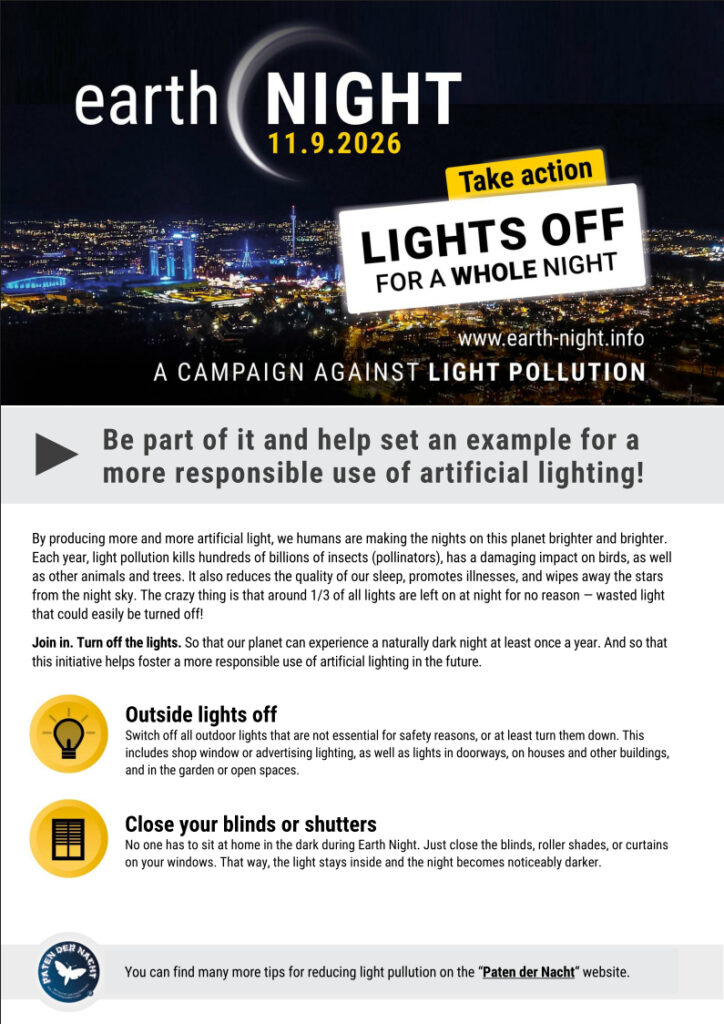
Outside light off

Switch off (or at least partially switch off) all light sources that are not essential for safety. For example, shop window / advertising lighting as well as door, house, object, facade and garden lighting.

Earth Night

Close blinds

Nobody has to sit at home in the dark during Earth Night because it is enough to simply close the blinds, roller blinds or curtains on the windows. This is how the night becomes darker.

Icons earth-night sterne

And then enjoy

Go outside, enjoy the starry sky and the magic of this one very special night, which is as nature intended: naturally dark. And maybe it will become clear that you would like to have such a night more often in the year and that one or the other light will no longer be switched on in the future ...

Here's what municipalities and cities can do:

Icons earth-night4-gedreht

Spotlights off

That is the lighting of carparks, statues, monuments or trees as well as the walls and/or facades of churches, bridges, palaces, offices, castles, tourist facilities or even schools.

Earth Night Straßenbeleuchtung, Straßenlaternen

Reduce/turn off street lights

This is possible in Germany, for example, because there is no general lighting requirement for public transport in the municipalities/cities in Germany. For the last Earth Night, for example, the municipalities of Bernau am Chiemsee (83233), Aschau im Chiemgau (83229) and Röthlein (09723) switched off all of their street lighting. Potential danger spots were secured with barges and signal/flashing lights. Feel free to inquire at these communities.

fakel

Turn Earth Night into an event. Let your place experience how nights looked like 150 years ago. Bring people together – with candles, torches, fire baskets, music and food.

General measures:

All light sources that „must“ stay on (e.g. for safety reasons) can be optimized in such a way that they still serve their purpose, but no longer light up the night unnecessarily and pointlessly:

Earth Night

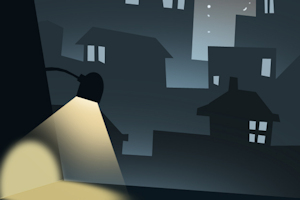
Light downwards

Light should only shine towards the ground, where it is actually needed. Because of this, tilt light sources downwards or at least shield them in such a way that nothing is lost laterally and upwards towards the sky. It is best to use reflector lamps. Since 100% of the light only shines downwards here due to the design, you can screw in much weaker lamps with the same brightness as before. In addition, continuous light can be avoided by installing a motion detector. All of this saves energy and CO₂ and reduces light pollution.

Earth Night

Use yellow

Yellowish light sources (up to max. 2700 K colour temperature) are the most night-friendly. With the same brightness, they dazzle significantly less, attract fewer insects, affect sleep less and contribute less to the formation of light domes over built-up areas. However, please never forget: for the environment and nature, the light that isn't even switched on is best.

General Information about Earth Night

Earth Night is an event during which people try to reduce artificial outdoor lighting as much as possible for one night a year. The goal (which will likely remain just a wish, however, because it’s not feasible): one night on the planet without artificial light. That would mean experiencing a night as it was every night until 150 years ago. But then artificial light came along …

This event always takes place on the Friday in September that is as close as possible to the night of the new moon. As soon as darkness falls (or by 10 p.m. at the latest), it’s time to turn off the lights! For an entire night.

A night with as little artificial light as possible!

Unlike Earth Hour (during which lights are turned off or dimmed for one hour every year on an evening in March starting at 8:30 p.m.), Earth Night is about turning off the lights — or at least significantly dimming them — from dusk until dawn.

Earth Night aims to draw attention to the problem of steadily increasing light pollution caused by our unchecked consumption of artificial light. All this light is making our nights brighter and brighter, and has been proven to harm the environment, people, and nature.

Unnecessary and misdirected light is a pure waste of energy and harms the climate. That much is well known. What is less well known is the full extent of the damage this light causes: It dims the starry sky and makes sleep less restful. It confuses plants and misleads birds on their migration routes. In the summer, it kills hundreds of billions of insects, which we and nature then lack as pollinators and which serve as the primary food source for most animals. Entire ecosystems are thrown off balance because of all the light at the wrong time.

So it’s time to use Earth Night to draw attention to the problem of excessive artificial light at night and the resulting steady increase in sky brightness. It’s high time to raise awareness and foster a more conscious use of light as a resource in our society of constant illumination. This is all the more important because there are still virtually no laws in place to curb light pollution. So far, policymakers have done far too little in this regard. Yet there is hardly anything else that allows for such quick, easy, and simple sustainable environmental protection as a change — that is, a more responsible — approach to light. In the face of the climate crisis, this is more necessary than ever.

Initiators

Earth Night was launched in the summer of 2020 and took place for the first time on September 17, 2020.

The event is an initiative of “Paten der Nacht” — a Germany-based nonprofit organization that works in Germany and Austria to protect the night and curb light pollution through educational outreach. “Paten der Nacht” is now supported by over 100 official supporters whom the organization has been able to recruit for the campaign.

Earth Night was launched by Manuel Philipp, a graduate engineer and the founder and director of “Paten der Nacht.”

paten-der-nacht-organisation-gegen-lichtverschmutzung

Everything you need to know about light pollution (its causes and consequences), as well as ways in which each of us can reduce it to a tolerable level (often using relatively simple means), can be found on the website of the organizers ► Paten der Nacht

The idea

A night on Earth with as little artificial light as possible.

The Earth Night is supposed to give the world an almost naturally dark night once a year. So that all living beings on this planet can experience a clear light/dark change at least once a year because life has been programmed by them for millions of years. It is even essential for maintaining health. The Earth Night is intended to be a regular reminder of how wasteful and thoughtless we are with artificial light and the great steps we are taking towards losing the night. The Earth Night is intended to create awareness of how necessary nature, humans and all other living beings need a dark night. It should make it possible to experience that life is also possible with significantly less artificial light and that the darkness of the night has an immense value that we have overshadowed, almost forgotten, due to sheer over-illumination.

Join in at least once a year so that:

  • A naturally dark night and the associated magic can be experienced
  • Everyone can see a beautiful starry sky directly above their house
  • Many millions of insects and thus pollinators are saved from death that night
  • People and all diurnal creatures can sleep more restfully
  • Countless nocturnal animals can get on with their actual tasks
  • Energy and CO₂ can be saved in the easiest way
  • We realise that we can (or could) get by with much less artificial light

The goal

Everything dark?

No, that shouldn’t be the goal! We humans need light at night. The aim should be that with every light source, in view of the knowledge about the possible harmful effects on the environment and nature, one asks oneself whether this is really necessary and absolutely essential. If this applies to the light source, then it should be designed to be as night-friendly as possible. As mentioned above: Yellow, no continuous light, no radiation to the side or upwards into the sky, not installed too high and the lowest possible power/brightness. All light sources that are not absolutely necessary, however, do not need to be installed and shine, above all those that illuminate natural areas (trees, hedges, meadows, bodies of water). Light does not belong on natural surfaces at night.

Raising awareness of light as a resource

We humans are still far too little aware that light is a resource. Just as naturally as we turn off the water tap after washing our hands, the stove after cooking or the living room light before going to bed, we should also naturally switch off our outdoor lighting at night. No church needs to still be lit up at 2 am at night. Likewise, no shop window and no billboard. And even where light is actually essential for safety reasons, nothing has to glow continuously, miss the target or be blindingly bright. Why do we bring up to 30 lux illuminance onto the street with modern LED street lamps when 1 lux would be sufficient in most cases? For comparison: the full moon creates 0.3 lux. Three times the full moon brightness, i.e. 1 lux, is sufficiently bright for every residential street.

Use the potential of the LED

A lot of light for very little money, easy to control and very flexible to use. This is what distinguishes LED lighting. But instead of using these properties for more environmentally friendly, night-friendly lighting, we humans go too far and install more and even brighter light that shines even longer because you can and because it doesn’t cost much to use. Overexposed nights are the result with all the resulting negative consequences. You’re proud of the fact that you need significantly less energy than with the old lighting technology, but much more energy could be saved with LED lighting if it were used more responsibly and in a more targeted manner. Reduce waste to zero. This would not only save a lot more money and relieve the climate, but also ensure extensive species protection.

Less light – more safety

Too many, too bright, too glaring LED streetlights dazzle road users. This achieves the opposite of what you actually want to achieve: namely more security. Weak, evenly distributed light that only shines downwards and is fully screened does not dazzle. This drastically increases security. There are fewer harsh contrasts. You see obstacles better and sooner, and you can see around you much better in the darker areas because you are not under a glaring cone of light that makes the surroundings invisible. The eye does not have to constantly get used to light/dark transitions while moving through traffic (which is all the more difficult the brighter and more pointed the light sources are). This also drastically increases security. And finally, it must be said very clearly: why do we light up roads when all users of the road are obliged to have their own light on the vehicle? Why don’t we just light up the pavements (if at all)? There is still a lot of educational work to be done on this topic. The Earth Night is intended to help and raise awareness.

Make it better all the time

Optimales Außenlicht wenig Lichtverschmutzung

Maybe the Earth Night is the trigger for permanently optimizing the outside light. Those who want to tackle the matter can use these

6 points for gentle outdoor light

Dates Earth Night

Always in September. Always on Fridays. Always at or near the new moon

Earth Night always occurs when it is naturally darkest, namely at the new moon or near the night of the new moon so that as many people as possible can enjoy and marvel at Earth Night and thus the beauty and magic of darkness (and then, if the weather is good, a breath-taking starry sky), we have decided from 2022 that Earth Night will always take place on Fridays. Nothing stands in the way of great Earth Night events.

This is Earth Night. Every Friday at or near the new moon in September. From nightfall; at the latest by 10 pm (CEST).

Earth Night took place for the first time on September 17, 2020. Namely in Germany and Austria.

The next dates for the Earth Night::

  • Earth Night 2027 | 03 September
  • Earth Night 2028 | 15 September
  • Earth Night 2029 | 07 September
  • Earth Night 2030 | 27 September

„What the microplastics are in our seas, lakes and soil, artificial light is in our atmosphere!“

Paten der Nacht (Godparents of the night)

You can use these templates freely:

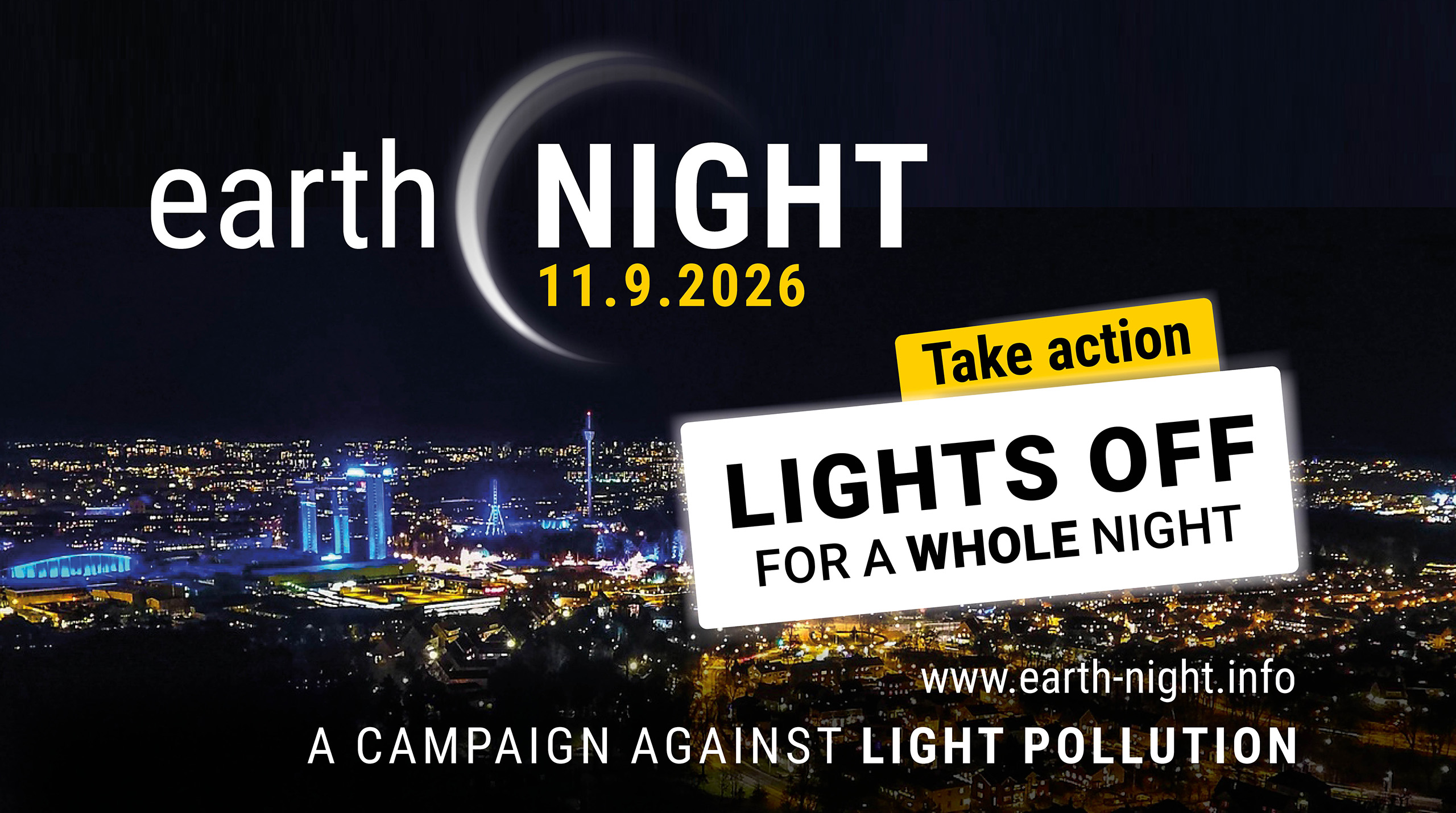
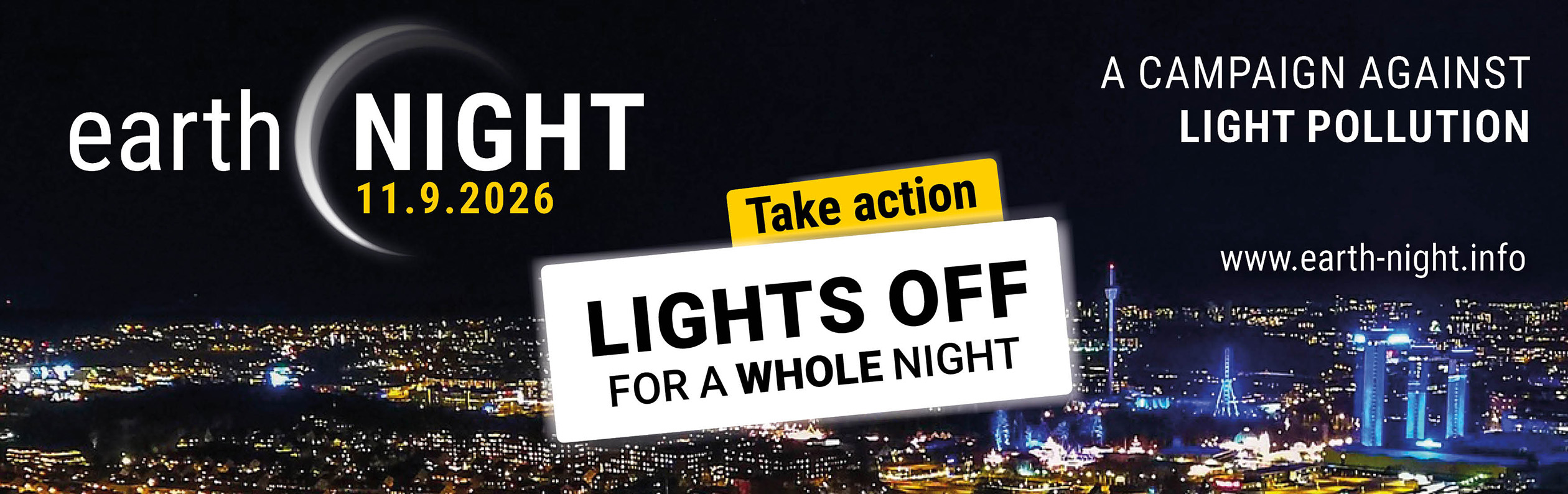
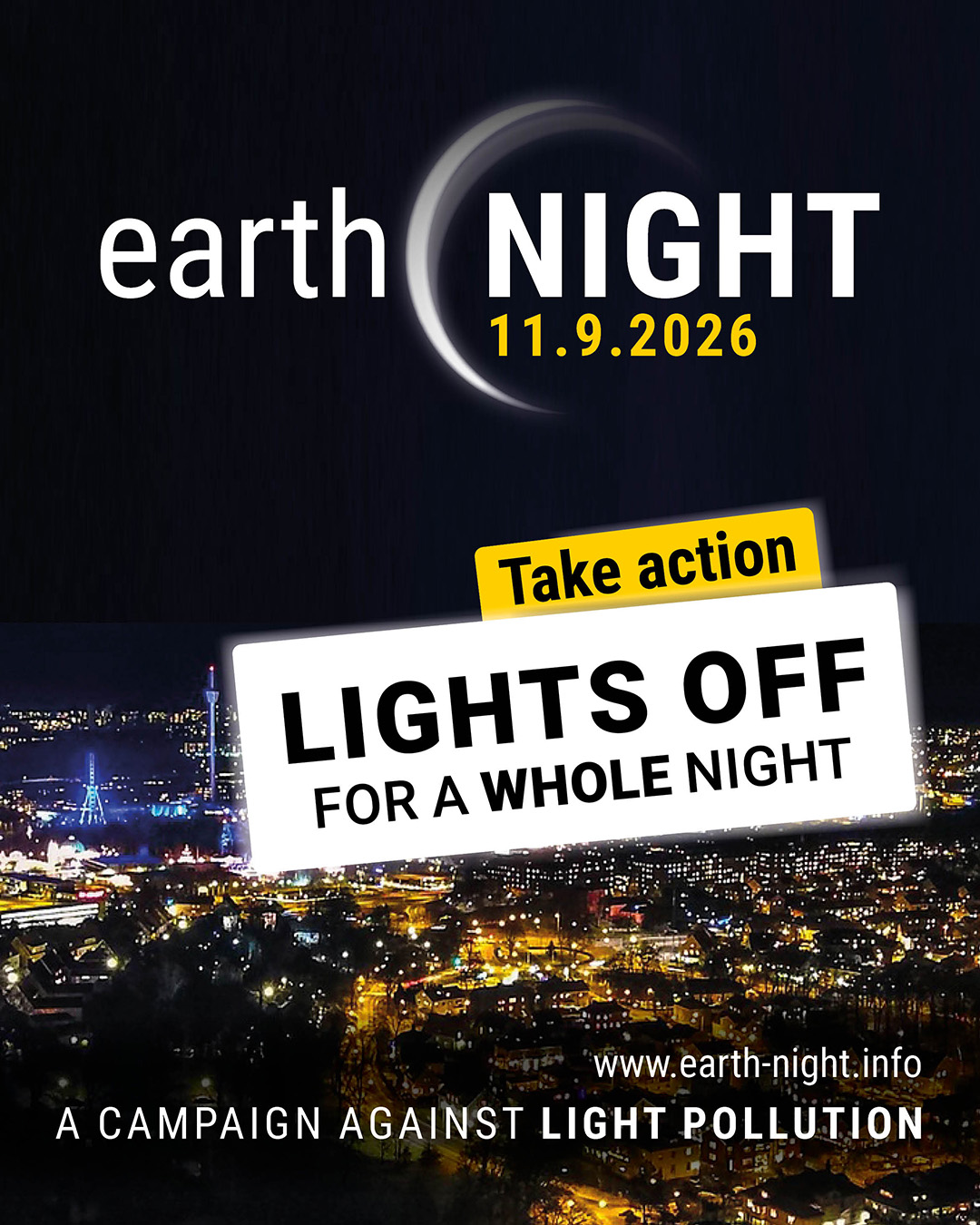
Web-Banner 2026

Web-Banner #1 (2560 x 1430 pixels)
Web-Banner #2 (2520 x 794 pixels)
Banner Instagram (1080 x 1350 pixels)

Mailing-PDF 2026

All information about Earth Night summarized on one page. Ideal for sending via email

PDF mailing campaigns
(general call)

Earth Night 2027

September

03sep20:00Earth Night 2027 | 3. September

03sep20:00Earth Night 2027 | September 3th

Nach oben scrollen